Week 0 Wrap-up
A look at the season ahead

The NHL season started, once again, with an under-hyped Europe series. This time, it was between the Buffalo Sabres and New Jersey Devils. Despite being gen z, I feel like a bit of a traditionalist. I want my NHL season to start on Wednesday night with the Toronto Maple Leafs and Montreal Canadiens facing off against each other for the millionth time. A 1:00 pm ET start on a Friday afternoon, televised on a channel many people don’t have, seems… less than optimal. And with ESPN stepping into the picture, our North American start is suboptimal with a 1:30 pm local time puck drop between the Seattle Kraken and St. Louis Blues.
Although the schedule makers may not give us what we want, or at least what I want, the vibes are high for the 2024-25 season. Particularly in the Atlantic Division where every spot seems to be up for grabs.
Team Projections
In this article, and throughout the course of the season, I will use two major data sources. The first is Evolving Hockey, where I host a podcast and occasionally write. Last week, projections for the season were released on Evolving-Hockey.com and Josh Younggren, the loudest of the EvolvingWild twins, wrote about Luke’s projections. It’s truly a team effort between the two. Josh eloquently explained the modeling process.
We still use a roster-level system, project various metrics for every player for next season (notably xSPAR and our own “game score” metric), determine the roster for every team (new this year, we’re gratefully using Tim Hiebert’s rosters from The Hockey News and research for injured players), aggregate those individual projections into team ratings for forwards / defensemen / goalies, and compute game probabilities for every game in the ’24-25 schedule. We then run a Monte Carlo simulation 50,000 times with all of that in place to project point totals for all teams in the league.
The Athletic also released their projections in a large set of previews, conquered by Dom Luszczyszyn, Sean Gentille, and Shayna Goldman. The idea of modeling on the individual player level holds consistent between the two models, however, The Athletic’s model revolves around Luszczyszyn’s Net Rating statistic released in 2023.
Offensive Rating: A weighted combination of goals, primary assists, secondary assists, individual expected goals, faceoffs, penalties drawn, expected goals for impact at five-on-five, goals for impact at five-on-five, power-play goal impact and usage.
Defensive Rating: A weighted combination of blocked shots, faceoffs, penalties taken, expected goals against impact at five-on-five, goals against impact at five-on-five, penalty kill impact and usage.
Both models are well-respected in the hockey community as they have a history of strong performance and constantly improve with more data and experience. They are also models that I feel I have a strong grasp on, which is important when digesting the results.
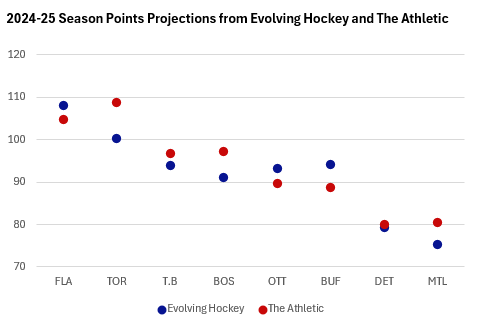
The two models are rather agreeable on the top and bottom pairs in the division; however, they project the middle of the division quite differently. The Evolving Hockey model has 3-5 as a complete toss-up between the Lightning, Sabres, and Senators, with Boston a two-point lag behind them. The Athletic has Boston and Tampa Bay, each who made the playoffs last season, as a considerable step ahead of Buffalo and Ottawa.
I don’t want to make this blog solely about Boston, but I do think they are the most interesting team heading into the season, and variances like this back that assertion up.
It’s potentially worth noting that Evolving Hockey uses The Hockey News as a source for rosters, and subs in Mark Kastelic and Mason Lohrei for Cole Koepke and Parker Wotherspoon. Additionally, Evolving Hockey’s model is much more indecisive on goalies, reducing their impact on projections, compared to The Athletic’s.
Josh expressed a fear of another Boston team led by goaltending in the Evolving Hockey preview article.
Boston (even with the assumption that Swayman will sign today) falls off quite heavily compared with last season. It’s not too surprising given their lack of depth outside of a few key players (Pastrnak, McAvoy, Marchand). I’m just preparing for another absurd goalie tandem year that will make us look ridiculous when they are first in the league and I run my evaluation for these projections in a few months.
The Athletic also made note of the Bruins free agent signings in Elias Lindholm and Nikita Zadorov. There seems to be a public perception that the two players are quite good, and that’s why they received contracts carrying an average annual value of $7.75 million and $5.00 million respectively. However, there has been a disconnect between the widely shared narrative and the hockey analytics community for some time.


Both players started last season on a disappointing Calgary team, were traded to Vancouver during the season, and finished their seasons below replacement level according to Evolving Hockey’s goals above replacement model.
While Lindholm has had a history of being a solid centerman and is a strong candidate to bounce back from a rough season, the same can’t be said about Zadorov. While Zadorov ideally fits in next to McAvoy on the top pair, Jim Montgomery has been going back to a Hampus Lindholm - Charlie McAvoy pairing in the preseason. Of course, there is a long season ahead and we haven’t even seen a regular season game for the Bruins yet.
While the Buffalo Sabres are off to an 0-2 start, the Evolving Hockey model was quite high on them for on core reason: youth. Jason Zucker is the only player in the lineup over the age of 30, and the entire top four on defense is below the age of 26. These players should be getting better year after year. And while the model doesn’t account for this, a change of voice with Lindy Ruff should help push that development…in theory.
Of course, youth can also yield questions, especially in net. What the Sabres will get out of Levi and Luukkonen remains to be seen. To me, the Sabres have shown a little bit of impatience lately by buying out Jeff Skinner and moving a strong prospect for Ryan McLeod.
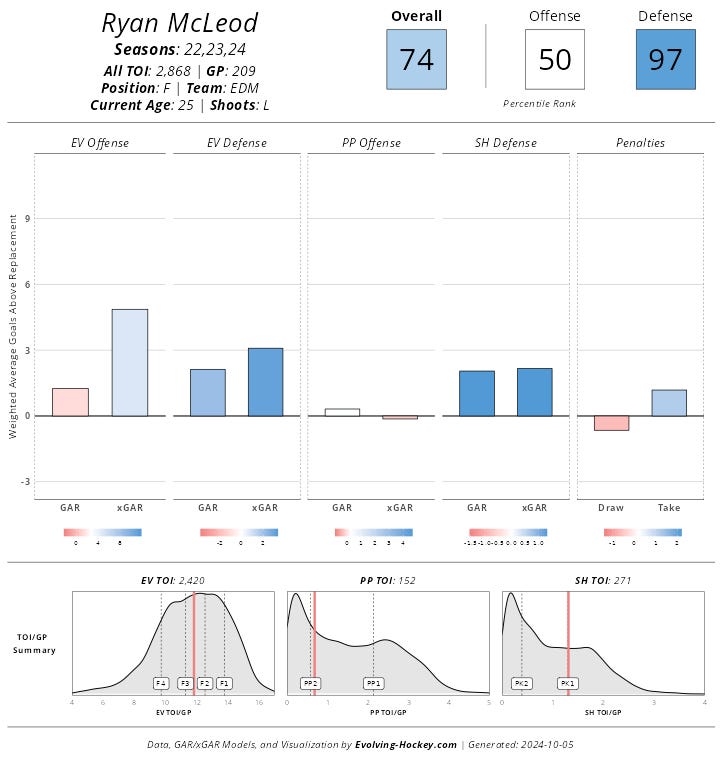
I really like what McLeod has to offer as a third-line center. His speed and defensive abilities offer great depth down the lineup. He won’t produce much without being on the wing of Draisaitl, but he should get the job done.
It appears we will have a dramatic, hopefully not too mediocre, race for the final division spot and at least one wild card spot for the Atlantic Division this season.
Early Injury Woes
The preseason has brought injuries upon us like it never has before. For the Canadiens, they received a massive blow with Patrik Laine and rookie David Reinbacher suffering long-term injuries in the same game. Then, you also had the awkward William Nylander injury, that was short-term.
And in our small amount of regular season play, the Sabres are going a man down for a while with JJ Peterka suffering a concussion from a hit early on in the second game in Prague.
In his sophomore season, Peterka shined with the Sabres last year with 28 goals, and 22 assists with an average ice time of 16.4 minutes. This season, both the Evolving Hockey and The Athletic models project another jump in production and ice time. Evolving Hockey forecasts 55 points with an average ice time of 17.3 minutes, while The Athletic is a bit more aggressive with 64 points in 18.1 minutes.
Beyond points, Peterka also shined with his ability to impact play at 5v5.
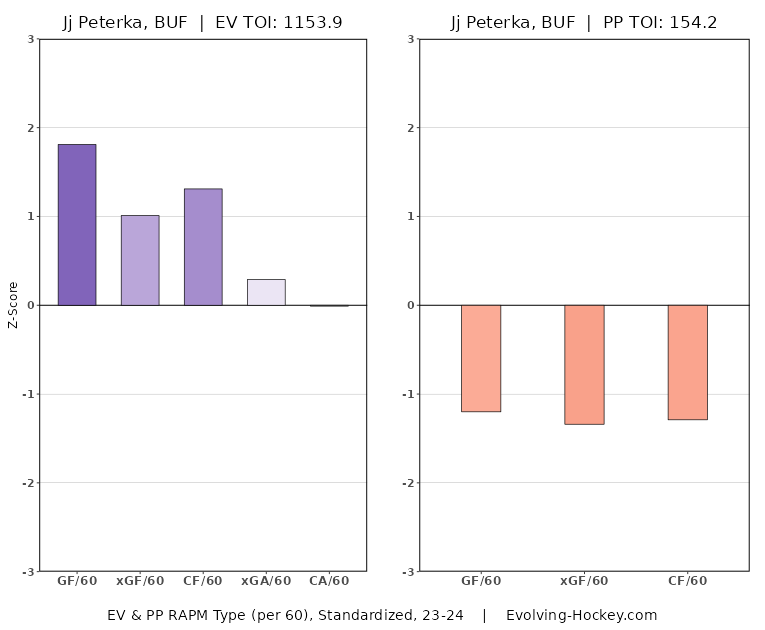
That was a big reason why he got the promotion to play alongside Tage Thompson and Alex Tuch to start the season. The threesome only played about 150 minutes together last season where they had a 72% share of goals, 44% share of expected goals, and a 53% share of all shot attempts.
There is no update on when to expect Peterka back in the Sabres lineup. Hopefully, the pending restricted free agent will be back soon.